
Training & seminars
Management training
Managing in Mauritius means leading a team that changes language depending on the subject, inside an organisation where people rarely contradict their superior in a meeting. Our programmes start there rather than from an imported model.
6 trainings

The manager-leader toolkit
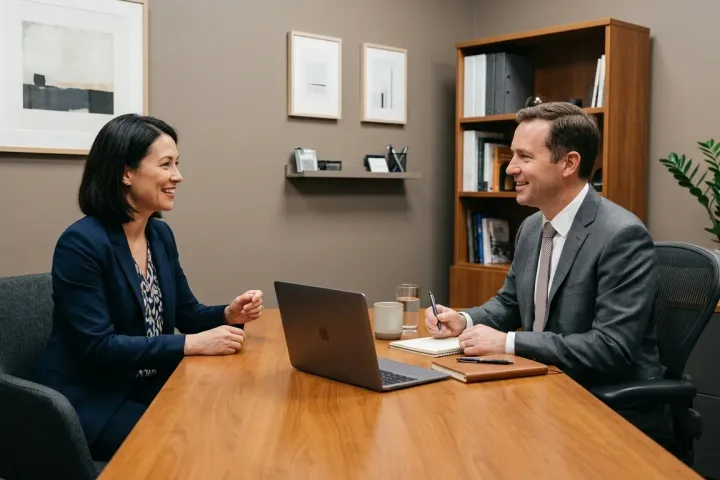
The firm's core programme, and the first one most Mauritian participants follow. Three days to stop settling things case by case: set a framework, correct without humiliating, delegate for real, and hold the one-to-one that the diary always drops first.
- Give constructive corrective feedback
- Bring someone back into line

Non-financial motivation levers and team coaching
When your best person gets an offer from Canada or Australia, the raise you can give does not compete. Two days on the levers you really control: autonomy, recognition, visible progress and meaning, adjusted person by person.
- Build a team's motivation agenda
- Set a challenge

Hybrid and remote management
Managing at a distance is not doing the same thing through a screen, and in Mauritius the distance is often in hours before it is in kilometres. One day to set clear rules from the start, write objectives that can be read without you, and keep rituals that do not wear away.
- Know the stages of managing at a distance
- Set clear objectives for remote and home working

Visual management: first level
A badly designed team board becomes a noticeboard nobody looks at after a month. One day to build yours, decide what deserves a place on it, and run the daily meeting so the team takes ownership of it rather than putting up with it.
- Understand the strengths and uses of visual management
- Strengthen your team's performance and sense of ownership
Managing with the Enneagram
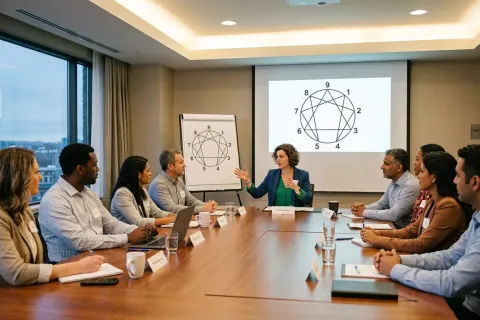
The same feedback produces a useful rethink in one person and a month of withdrawal in another. One day to recognise your profile, read your team's, and stop managing everyone as if they wanted what you want.
- Know the 9 bases of the Enneagram
- Know your own personality base in the Enneagram

Leading change with the Kotter method
In Mauritius, a reorganisation announced in a meeting often gets silent agreement, and the objections show up three months later in the results. Two days on Kotter's eight steps, applied to a change you are actually leading.
- Understand the human mechanisms of change, and adapt your posture as a manager accordingly
- Master the 8 steps of the Kotter method to steer a transformation project in a structured and effective way
Most management training assumes a common foundation: that everyone in the room has learned roughly the same things about hierarchy, disagreement, and how to say no. In Mauritius that assumption does not hold. A team of ten in Port Louis, in Ébène or on a production site works in Kreol, French and English depending on who is in front of them, and brings together backgrounds that run from a local apprenticeship to a degree taken abroad.
On top of that sits a local reality few programmes take seriously: the distance to a superior is respected here, and it is respected in silence. A manager can leave a meeting with everyone's agreement and find three weeks later that nothing has moved, not through bad faith, but because the disagreement had nowhere to be said. Our programmes work on that point explicitly: how to get an objection before the decision rather than after it, and how to hold a frame without the team simply nodding it through.
Before the technique (delegating, setting objectives, running a difficult conversation) participants map how they themselves operate and how the people around them do, using DISC and the Enneagram. That is what makes the technique hold: a delegation method that works on one profile fails on another, and the manager needs to know which one is sitting in front of them.
Every programme is modular. A manager who already runs good one-to-ones but freezes in conflict does not need the whole training; they need two modules. Tell us the gap and we will assemble the shortest programme that closes it.
Companies that have put their trust in ABP














Frequently asked questions
Who are these management trainings for?
Team leaders, middle managers and business owners in Mauritius, from the manager taking on their first team to the one who has been managing for ten years and wants to work on a specific point. Groups are usually formed by level, so that the examples stay useful to everyone in the room.
What languages are the trainings delivered in?
French, English or Spanish. The choice is made per programme rather than per participant: a group settles on a working language before the session. Both of this site's languages are also delivery languages, which is not the case everywhere: a francophone group and an anglophone group from the same company take the same programme without it being rebuilt.
How long is a management training?
One to three days depending on the programme. A training can also be split into half-days across several weeks, which often suits managers who cannot leave their team for consecutive days.
Do you deliver at our own offices?
Yes, and it is the most common format for management. It allows work on real situations from your own team rather than on generic cases. Sessions can also run online, or combine the two.
Do participants receive a certificate?
Participants receive an attendance certificate from ABP Consulting naming the programme and its duration. These are professional development programmes, not qualifications recognised by an awarding body, and we say it that way rather than let a diploma be assumed.
Is prior management experience required?
Not for the manager-leader toolkit, which is the entry point and also suits a first appointment. Non-financial motivation levers and team coaching comes next: it assumes the first programme, because it starts from what participants have made of it in the field.